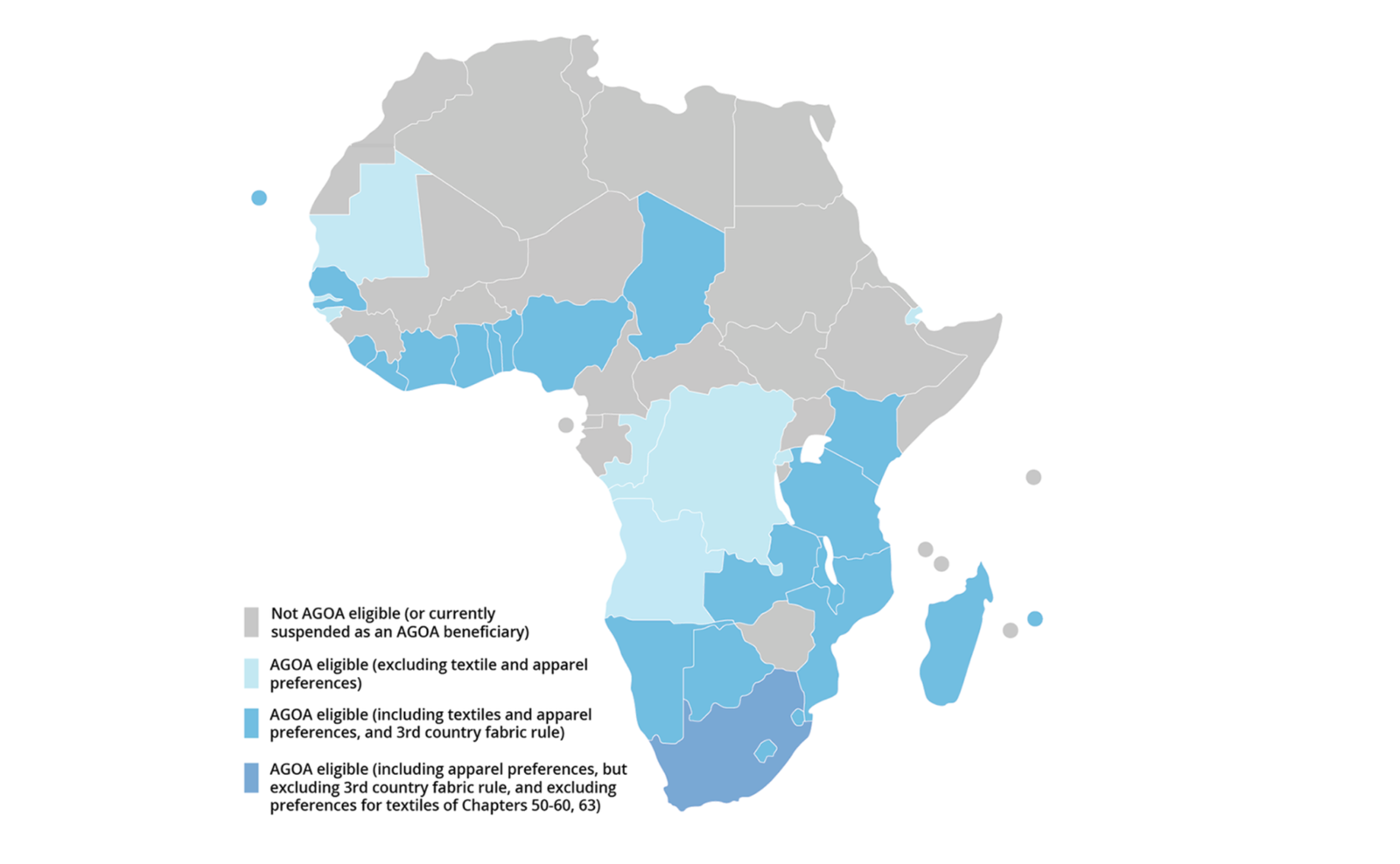
The African Growth and Opportunity Act (AGOA) is one of the most important trade frameworks between the United States and Sub-Saharan Africa. Since 2000, it has granted eligible African countries duty-free access to the U.S. market for thousands of products—most notably textiles, apparel, agriculture, and light manufacturing.
For many African economies, AGOA has not just been a tariff benefit; it has been a catalyst for industrialization, export diversification, and job creation.
What Is AGOA?
AGOA is a U.S. trade law that allows qualifying Sub-Saharan African countries to export 6,000+ product lines to the U.S. duty-free and quota-free.
Core objectives
-
Promote export-led growth
-
Encourage market reforms and rule of law
-
Attract investment into manufacturing and value addition
-
Integrate African economies into global supply chains
A Brief History of AGOA
| Year | Milestone |
|---|---|
| 2000 | AGOA signed into law in Washington |
| 2004–2015 | Renewals and expansions; apparel rules of origin made more flexible |
| 2015 | Extended to 2025 with stronger eligibility criteria |
| Today | Debate on renewal and modernization beyond 2025 |
AGOA eligibility is reviewed annually and tied to governance, labor rights, and market openness.
Who Benefits Most?
Apparel has been the standout winner, but not the only one.
| Sector | Typical Exports Under AGOA |
|---|---|
| Apparel & Textiles | T-shirts, jeans, uniforms, knitwear |
| Agriculture | Coffee, cocoa, fruits, nuts, flowers |
| Automotive | Components and assembled vehicles (select countries) |
| Light Manufacturing | Footwear, handicrafts, processed foods |
Countries that scaled fastest under AGOA
-
Kenya (apparel hub)
-
Lesotho (garment exports)
-
Ethiopia (industrial parks, textiles)
-
Madagascar (textiles rebound post-reinstatement)
Why AGOA Mattered for Industrialization
AGOA changed investor logic:
“Produce in Africa for the U.S. market.”
This drove:
-
Industrial parks focused on export apparel
-
Asian and Turkish manufacturers setting up African factories
-
Skills transfer and formal job creation
-
Women’s employment growth in textiles
Logistics & Supply Chain Effects
AGOA didn’t just create factories—it reshaped corridors:
-
Inland production zones connected to ports like Port of Mombasa
-
Air freight for perishables to U.S. gateways
-
Compliance upgrades in customs and certification
-
Growth of bonded warehouses and export processing zones
Challenges and Criticism
Despite success, AGOA faces structural limits:
-
Heavy dependence on apparel in a few countries
-
Limited value addition beyond basic assembly
-
Strict compliance and documentation
-
Vulnerability to political eligibility reviews
-
Uncertainty after 2025
AGOA vs AfCFTA: Complement or Conflict?
AGOA connects Africa to the U.S.
AfCFTA connects Africa to itself.
Together, they can:
-
Build regional value chains that export finished goods to the U.S.
-
Encourage specialization (fabric in one country, stitching in another)
-
Reduce overreliance on a single gateway economy
What Happens After 2025?
Key questions under discussion in Washington and African capitals:
-
Renewal as-is, or a modernized “AGOA 2.0”?
-
Shift from tariff preference to deeper investment partnerships?
-
Integration with climate, digital trade, and supply-chain security agendas?
For African exporters, predictability is now the biggest concern.
Strategic Takeaways for African Businesses
-
Invest in compliance and certification early
-
Build regional supplier networks (AfCFTA leverage)
-
Move from basic assembly to higher value addition
-
Use AGOA to attract partners, not just buyers
Conclusion
AGOA has been more than a trade preference. It has been a development instrument, a logistics catalyst, and a bridge between African factories and American consumers.
As 2025 approaches, the opportunity is not just to renew AGOA—but to upgrade it into a framework that supports Africa’s next phase of industrial growth.