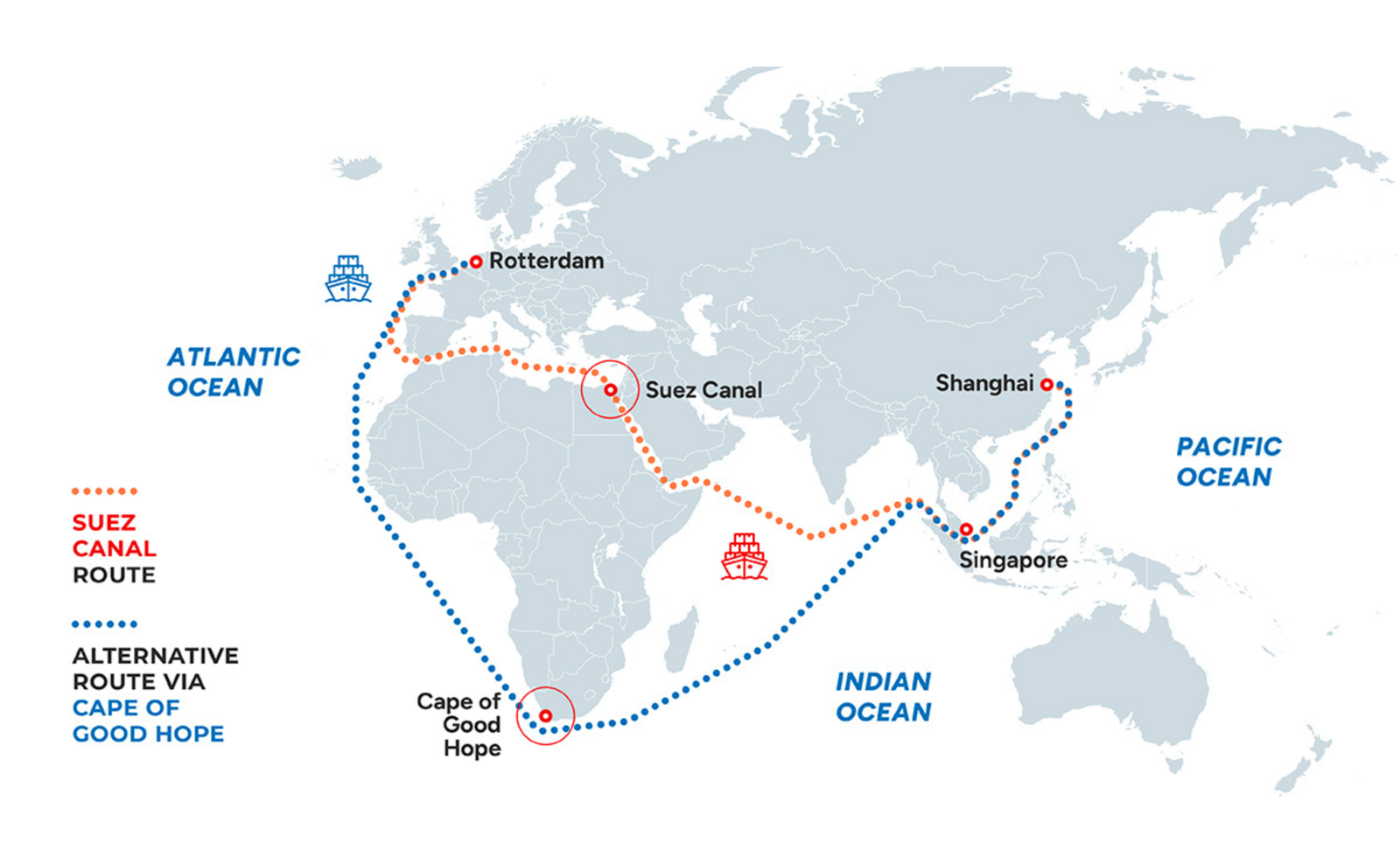
The escalation of tensions in the Middle East and the Red Sea has reshaped global maritime trade routes, bringing renewed strategic importance to the Cape of Good Hope route around the southern tip of Africa. Traditionally used before the opening of the Suez Canal in 1869, this route has once again become a critical alternative for global shipping lines seeking to avoid security risks in the Red Sea and the Bab-el-Mandeb Strait. The shift illustrates the fragility of key maritime chokepoints in the global logistics system, where more than 80% of global trade volume is transported by sea.
The disruption intensified after attacks on commercial vessels in the Red Sea starting in late 2023, forcing major carriers such as Maersk, MSC, CMA CGM, and Hapag-Lloyd to reroute vessels away from the Suez Canal. As a result, container ship traffic through the canal dropped sharply, with some periods showing up to a 90% decline in transits compared with normal levels, according to World Bank and industry analyses. The diversion of vessels around Africa led to a surge in maritime traffic near the Cape of Good Hope, with shipping activity in that corridor increasing by as much as 80% in some analyses of vessel tracking data.
However, the Cape route comes with operational consequences. Sailing around southern Africa can add 10 to 20 days to Asia–Europe shipping journeys and increase fuel consumption significantly, sometimes requiring up to 40% more fuel compared with the Suez Canal route. These longer voyages reduce effective shipping capacity and contribute to higher freight rates and insurance costs. Economists estimate that such rerouting can reduce global container shipping capacity by about 9% due to longer transit times.
Despite these challenges, the renewed use of the Cape of Good Hope corridor highlights Africa’s strategic geographic position in global trade. Ports along the African coast, particularly in South Africa, Morocco, and West Africa, could see increased maritime activity as shipping networks adapt to geopolitical disruptions. For the African logistics ecosystem, the situation underscores both risks and opportunities: while global instability can disrupt supply chains, it also reinforces the continent’s importance as a central corridor in international maritime transport.