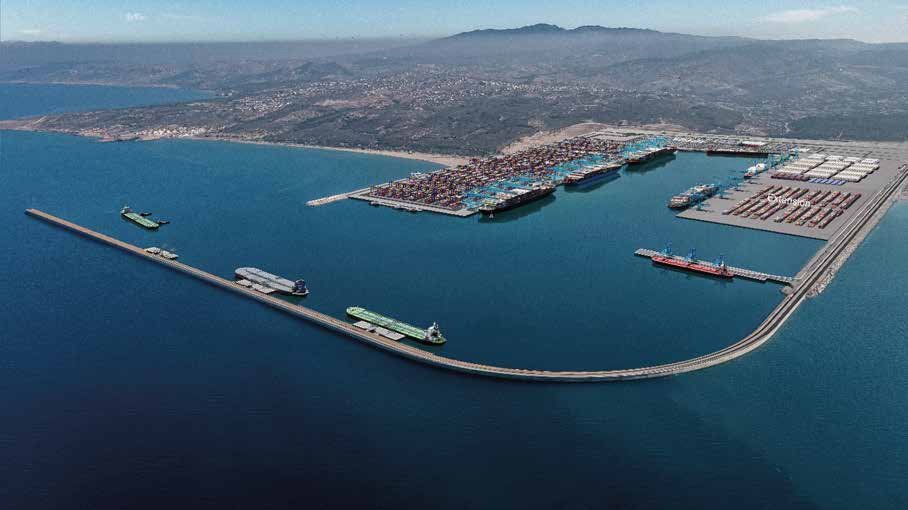
Designed to complement existing maritime hubs and strengthen regional connectivity, Nador West Med is positioned to become one of the Mediterranean’s most advanced port and industrial platforms.
Located on Morocco’s northeastern coastline, near the city of Nador, the Nador West Med project represents one of the most ambitious logistics and industrial developments currently underway in Morocco. Conceived as both a deep-water port and an integrated industrial ecosystem, the platform is expected to reshape trade dynamics across the western Mediterranean while reinforcing Morocco’s role as a regional logistics powerhouse.
A Mega Infrastructure Project by Design
Nador West Med is being developed as a multi-purpose port complex capable of handling large vessels and diversified cargo flows. Built on a coastal site offering natural deep waters, the port is engineered to accommodate next-generation maritime traffic and industrial activity.
Key infrastructure elements include:
- More than 1,500 hectares of port and industrial space
- A main deep-water port basin exceeding 18 meters in depth
- Over 7 kilometers of quays planned across multiple terminals
- Dedicated facilities for containers, hydrocarbons, bulk cargo, and industrial logistics
This configuration positions the port to attract major shipping lines while supporting high-volume industrial operations.
Capacity Targets and Operational Vision
Once fully operational, the port is expected to deliver substantial throughput capabilities:
- Container capacity: approximately 3 million TEUs annually in long-term projections
- Hydrocarbon terminal capacity: estimated 25 million tons per year
- Bulk cargo handling: several million tons annually depending on commodity flows
These figures place Nador West Med among the most significant emerging maritime platforms in North Africa.
The objective is not merely to create another port, but to establish a multi-flow logistics hub capable of supporting energy, manufacturing, and trade simultaneously.
Strategic Goals Behind the Project
The development of Nador West Med aligns with broader national logistics ambitions. Its core goals include:
Diversifying Maritime Gateways
While Morocco already operates major ports, expanding capacity reduces concentration risk and enhances national resilience against congestion or disruption.
Strengthening Energy Logistics
The hydrocarbon terminal is expected to play a major role in securing energy imports and supporting downstream industrial activity.
Accelerating Industrialization
The adjacent industrial zone is designed to attract investors in sectors such as petrochemicals, manufacturing, logistics services, and export-oriented production.
Enhancing Regional Connectivity
Positioned near key Mediterranean shipping routes, the port offers shorter transit paths between Africa, Europe, and the Atlantic corridor.
Beyond Morocco: A Regional Platform
Nador West Med is not intended to serve domestic trade alone. Its geography makes it highly relevant for broader regional supply chains.
Potential regional benefits include:
- Supporting transshipment flows across the western Mediterranean
- Providing an additional logistics option for North African trade
- Strengthening links between African production zones and European markets
- Offering new routing flexibility for global carriers
As supply chains increasingly prioritize redundancy and network diversity, emerging hubs like Nador West Med gain strategic importance.
Industrial Integration as a Competitive Advantage
One of the project’s defining characteristics is the integration between port infrastructure and industrial development. Rather than functioning solely as a maritime gateway, the platform is designed to support port-centric manufacturing, where production sites operate in close proximity to logistics facilities.
This model reduces inland transport requirements, shortens lead times, and improves cost predictability — all critical factors for globally competitive industries.
Economic and Trade Implications
Large-scale infrastructure projects typically generate ripple effects beyond logistics performance. Nador West Med is expected to:
- stimulate foreign direct investment
- create employment across maritime and industrial sectors
- reinforce Morocco’s positioning within global value chains
- support export growth
For supply chain planners, the emergence of new deep-water capacity often signals future shifts in routing strategies and cargo distribution patterns.
A Signal of Africa’s Logistics Transformation
Across the continent, governments are investing heavily in port modernization to accommodate rising trade volumes and larger vessels. Nador West Med reflects this broader transformation — one in which infrastructure is increasingly viewed as a strategic lever for economic competitiveness.
As global trade routes evolve and supply chains seek reliability, the success of such platforms will depend not only on physical capacity, but also on operational efficiency, connectivity, and ecosystem development.
Nador West Med illustrates a growing reality: Africa’s logistics landscape is expanding, diversifying, and preparing for the next generation of maritime trade.
SupplyChainAfrika.com
Tracking Africa’s logistics infrastructure and the forces shaping global supply chains.